MATHter Mind

Math is a powerful force in my life.

In school, you are taught how basic math skills will become part of your everyday life. It’s not just a problem on the chalk board or on your homework. You will use math every day in countless ways: figuring how much change you’ll get when you pay with a $20, what is a 20% tip on a $15.65 meal, how much flour do you need if you are doubling the recipe, etc. It’s easy to think of professions and situations where a miscalculation can be disastrous and detrimental. A mistake in a budget can cost a company thousands or even millions of dollars, a builder’s wrong measurement can compromise an entire structure, or a doctor’s miscalculation of dosage could be lethal. However, for most of us in our every day lives, the consequences of our calculations are not as significant or potentially harmful.

Diabetes changed all that for me. It’s a disease of countless and continuous calculations. And while technology has aided with some of the calculations thanks to features like the bolus wizard, there is still so much that the individual must figure out. But unlike a school assignments where a wrong answer is designated with a red “X” or minus points, a miscalculation for me has a direct effect on my health. This was clearly demonstrated to me last night.

Carb counting in theory is simple, you take how many carbs are in a food and divide by your carb ratio (how many units of insulin to give for a certain number of carbs) which is determined by your doctor. For instance, if your carb ratio is 1:15, for every 15 grams of carbohydrates, you would give 1 unit of insulin. However, in actuality, carb counting is never that simple. When it comes to meals, you can rarely just look on the box and have a magic number, most meals are a combination of foods in different proportions, and many not coming from a box. Even looking online for “lasagna” can give you a rough idea of the number of carbs, but it’s still going to vary based on the ingredients you used and your serving sizes. I’m also more of a grazer when I eat, a little of this, a little of that, more of this, which definitely doesn’t make the process easier.

Here’s what went down last night:

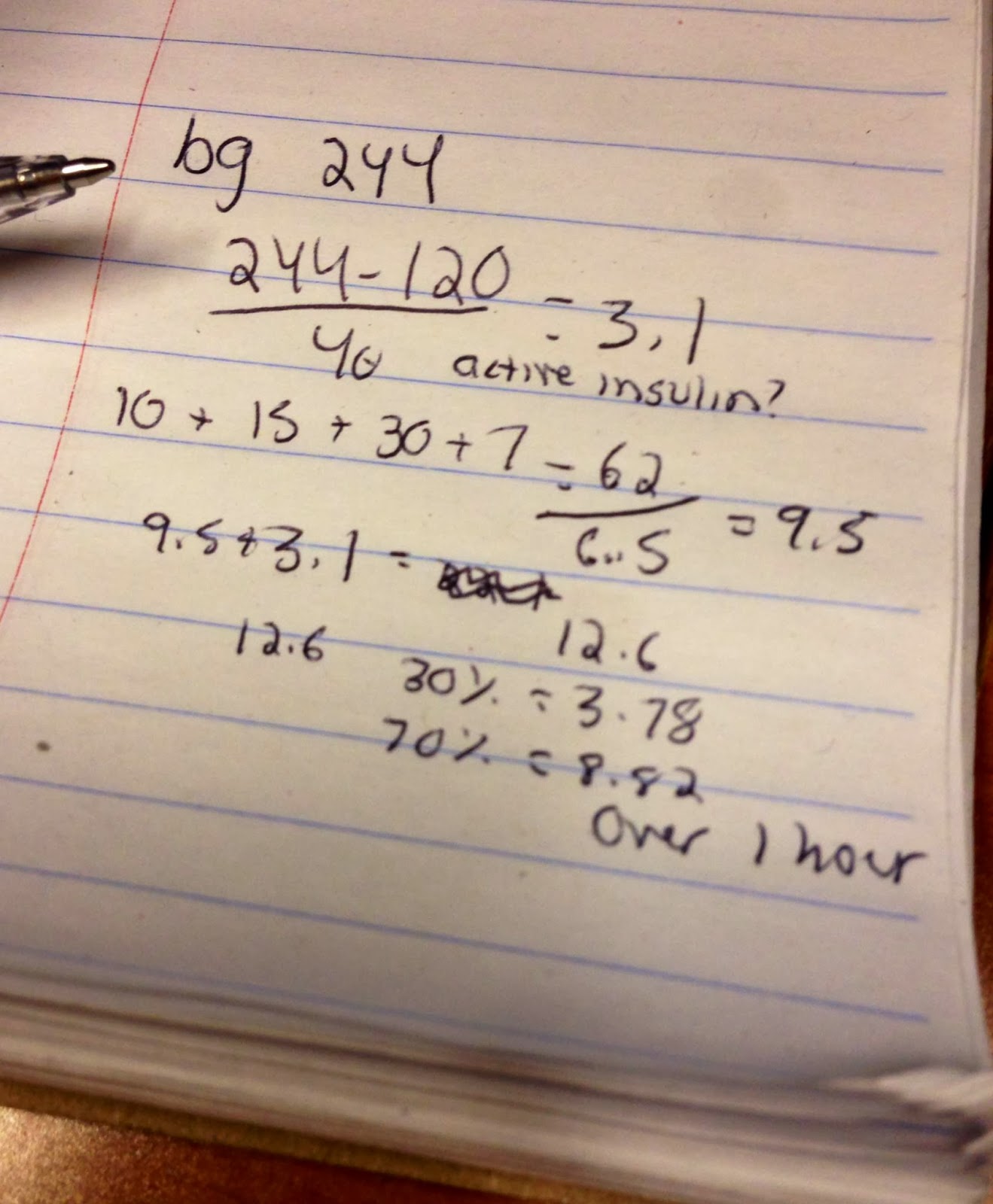
Pre-dinner blood sugar: 244
Too high so should correct for that first. 244- 120/40= 3.1 units
Dinner: Smorgasbord of leftovers and prepared food from local grocery store.

Spoonful of brussel sprouts and small serving of grilled vegetables. Well there probably isn’t a lot of carbs in the vegetables, maybe around 10 based on my serving.
Sliver of pizza. Well I know roughly how many carbs are in a normal piece of pizza, but is this piece bigger or smaller? But I only had 1/3 of the piece, so should I just divide a typical piece of pizza by 3?

1/2ish cup of risotto. Granted I didn’t actually measure it, but it was roughly 1/2 a cup, I think? But I don’t have a box to look at since we bought it prepared. I guess I’ll estimate based on looking it up in the past.

A few more bites of pizza. How many carbs in a few bites?

I added this all up and put the total carbs into my pump which divided it by my carb ratio for this time of day.

Then it was on to dessert. I made a cup of decaf coffee and put some flavored creamer in. A few carbs in that. Then the desserts came out. I couldn’t even tell you what I was eating, let alone how many carbs are in them. Some kind of sugar covered fried muffin, a lemon cake thing, and some other kind of bar. My family cut off little pieces of each and picked from the plate, a typical style of eating in my family, but hard to determine just how much I ate and how many carbs it is. I took my best guess.

I felt relatively confident in my decisions that night. It was a more difficult meal with so many different types of foods and different portion sizes. However even if I was off, I didn’t think I’d be off by more than 10ish carbs.

Boy was I wrong.

Somewhere along the way I had miscalculated, and around 10:30 pm about 2 hours after our late dinner and when I was all ready to go to sleep, my blood sugar fell to 42. Not that a low is ever pleasant, but this particular low was a bad one. I laid in my bed, shaking, light headed, disoriented, feeling awful. Where did I go wrong?! How were my calculations this far off??

It’s not often that this happens, when I am so off in my calculations. When I think about the fact that I do this at least 3 times a day, every day for 13 years, I can say that I’m typically pretty good at carb counting. When I am off, I more likely end up with a high blood sugar instead of a low. However, it’s these rare instances that remind me how important math has become in my life. One miscalculation hours earlier can drastically effect my health and how I feel.

Now that is some powerful math.
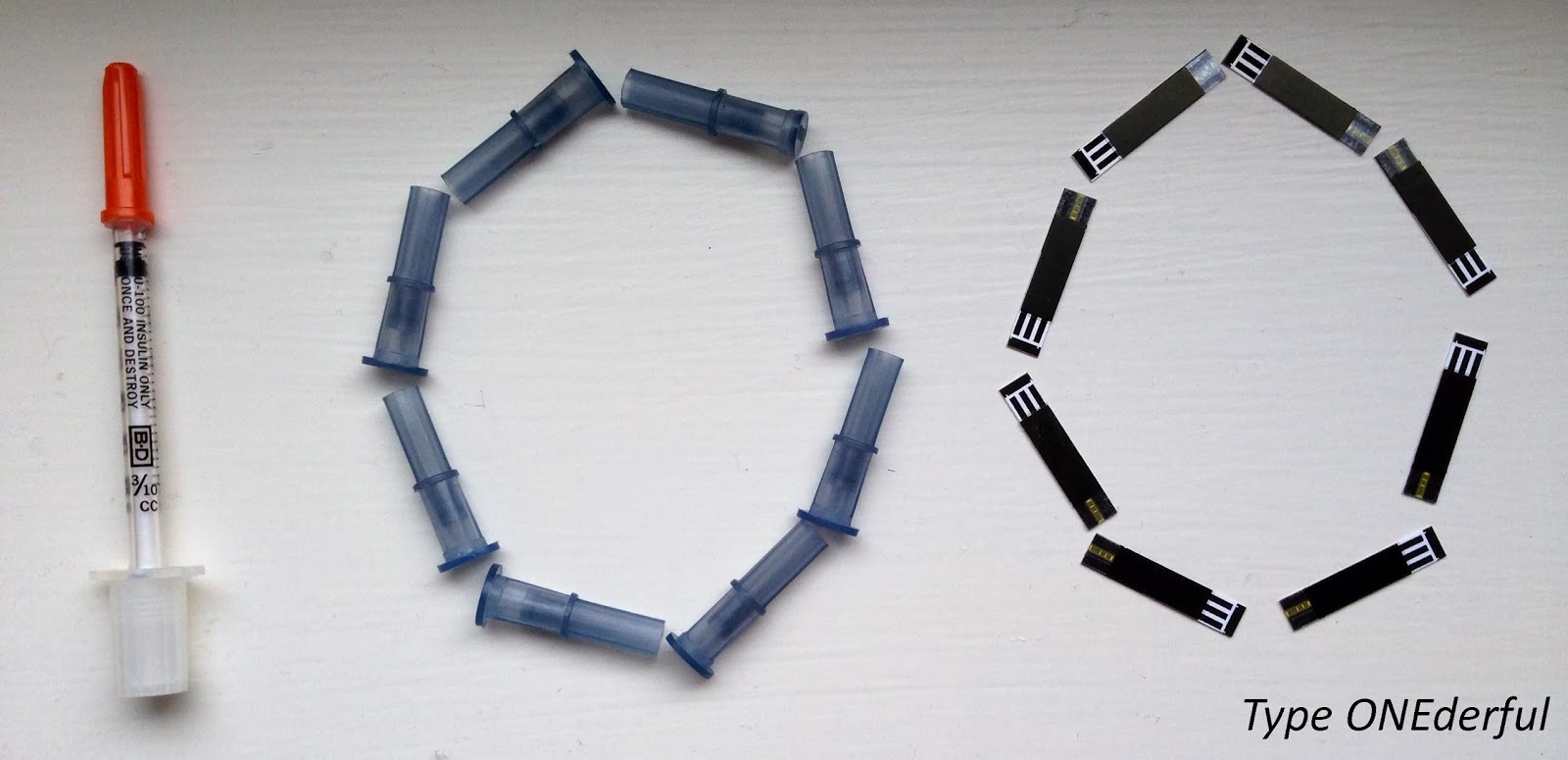
100th Post, 100 Days

I was racking my brain for what this post should be about, it seems that my diabetes has been operating in the background lately. It’s been humming along at a pretty steady tone, no blaring alarms to garner attention and a blog post. I’m not complaining, it’s nice to not have it be constantly on my mind.

I was staring at my posts when I noticed a number, this is my 100th blog post. I felt that it warranted some sort of recognition. A number that can be celebrated.

At first I thought of doing some kind of list, you know the “Top 100” type of lists. But I was having trouble either thinking of 100 or the list wasn’t very exciting…

100 names that I’ve called my glucose meter:
1. pokey
2. meter
3. that damn thing
4. thingamajig
5. blood sucker
6. glucose gizmo
7. Dracula
8. the pricker
9.

100 places where I’ve gotten a low blood sugar:
1. in the car
2. at my house
3. at school
4. at work
5. on the tennis court
6. walking down the street
7. while at the gym
8. at the movies
9. in my bed

This list would probably be well over 100…

100 things others have asked or told me about my diabetes
1. so you can’t have sugar?
2. That’s the bad kind, right?
3. Can you eat that?
4. Can’t you just take that pill?
5. A raw foods diet can cure diabetes
6. Don’t worry, that won’t happen to you, your diabetes is controlled
7.

Instead, I decided on “100th Post, 100 Days.”  This post is dedicated to a glimpse of what 100 days of diabetes looks like for me. While I can’t quantify every experience, every emotion and feeling, and every minute living with diabetes, here’s what 100 days does mean for me:

  • 34 set changes. That means filling my insulin pump with insulin and inserting it into my stomach 34 times.
  • 10 sensor changes. I’ve been getting roughly 10-12 days out of my Dexcom CGM sensor, so I will have reinserted it under my skin around 10 times.
  • At least 300 finger pokes, although likely many more. This is assuming I test my blood sugar using my finger 3 times a day, but some days I test many more.
  • A conservative estimate of 70 packs of fruit snacks. I don’t go low every day, but there are times when I go low 3 times in one day, so 70 seemed like an accurate estimate.  But whether that number is closer to 50 or 80, it’s still a lot of packs of fruit snacks!
  • Around 9 vials of insulin
  • Roughly 50 interrupted nights of sleep with a beeping CGM indicating low and high blood sugars
  • Hundreds of dollars spent on supplies and doctor visits…after insurance
  • One visit with my endocrinologist
  • reading tons of blog posts in the DOC, filled with laughter, tears, frustrations,  and triumphs and around 14 of my own blog posts

So here’s to 100 blog posts! 100 posts providing a window into these last 14 months with diabetes. Hopefully you’ve enjoyed reading them as much as I’v enjoyed writing and sharing them.

Fleeting

This too shall pass.

This is one of my favorite quotes. I find solace among these words, as even now I turn to them for comfort. To me, it is a reminder that this moment or what you’re feeling right now will soon fade away. If it’s bad, you will get through it, things will get better. If it’s good, cherish the moments because they too will pass.

It’s a reminder of the temporary nature of much of our experiences and emotions; pleasure and pain, sadness and joy. It’s a warning to live in the now. From a broken heart to a broken leg, this phrase offers hope.

While this proverb has helped me through many moments in my life, applying it to my life with diabetes proves more difficult.

A chronic disease is by definition, well, chronic. It’s long lasting, it continues, it does not pass. Until there is a cure, it is something that I am stuck living with for the rest of my life. On a bad diabetes day I can find comfort in the fact that tomorrow is a new day, but it’s still a day with diabetes. So what do you do? What can you do?

You accept it.

You let your anger pass. You let your frustrations pass. You let your sadness pass. You let the pain pass.

You may not be able to change what happens to you, but you can change how you respond to it. The only chronic part of diabetes is the disease itself, not how you feel about it. So why hold on to the negative, when it too can pass.

The Other Room

I sit down at the table to eat. It’s past 1 and I’m starving. I don’t know what my glucose number is; my meter is upstairs. I take a bite. I don’t want to go up and get it. Pretty soon my lunch is gone. I left my diabetes in the other room.

I’m snuggled under a blanket. Snow is falling outside, piling high against the window. Flames flicker and dance in the fireplace as the heat warms my frozen toes. I hear a faint buzz from the other room. My CGM is telling me something: too high, too low, dropping, rising. I don’t listen. I left my diabetes in the other room.

We’re gathered around the table, 6 friends enjoying each other’s company and a delicious dinner. The waitress asks if we want dessert. A slice of giant chocolate layer cake is served with 6 forks. I take one and dig in, savoring each rich bite. Chocolate cake, chocolate frosting, raspberry sauce. I left my diabetes in the other room.

My pump lays on top of a pile of crumpled clothes. I’m untethered, liberated, disconnected. I jump into the pool. I left my diabetes in the room.

I’m in a meeting, staring at the computer projection on the screen. The words are there, but I can’t make sense of them. My head feels heavy, my hands shaky. My CGM is back at my desk. I left my diabetes in the other room.

Didn’t I? 

My heart rate quickens, my hands get clammy. I can’t think straight. I’m getting dizzy.

I didn’t leave it. I can’t leave it.

It’s always here.