The Endo Intro

I tend to “reward” myself with two things: new nail polish or fancy drinks from Starbucks. With my skinny chai tea latte in hand, I prepared myself for what was about to happen: the endo appointment *cue dramatic music*.

I’m going to be honest, I was going into this appointment with a slightly sour mood. You see, I had been informed via a piece of paper in the mail that my appointment date, time, and DOCTOR had been changed. When I called to inquire, they told me that my current doctor wasn’t seeing patients right now. I felt like I had been dumped. I’ve been seeing this doctor 4 times a year for about 5 years. She’s the one that worked with me to get my best A1c in years at my last appointment. But now she left without a letter of explanation or even a goodbye! Did our time together mean nothing to you, Dr. H?! I thought we had a connection, I thought you were there for me…

So while I was sure this new doctor who I have never met before would be fine, I was still a little bitter. I also knew that my A1c would not be as good as last time. I had been running high during the night, for a few weeks when I had an infection, and had slipped up on some of the bad habits I’ve been working to change. I just didn’t know how much higher it would be.

So I sat in the exam room waiting to meet this new doctor and hear my A1c, while catching up on other Dblogs (might as well do something enjoyable while I wait). When she walked in, she was all smiles. We introduced ourselves and she told me my A1c was 7.0. Eh not the amazingness I’m hoping for, but I’m okay with it for now. Recap: started in November at 8.0, then 7.2, then 6.7 (!!!), and now back up to 7.0. Since there hasn’t really been much of a pattern to my highs and lows, the doctor didn’t really make any adjustments. I know what I need to work on and so that’s what I’ll do. She ordered some blood work and I was on my way. I did learn something interesting though. The doctor wanted to do a blood test for celiacs disease. I know that diabetics are at a much higher risk for celiacs, but I thought that you’d only test someone if they were having stomach pains. She told me that most people are asymptomatic and don’t even know they have it. I’ll know in a few days if I can cross this autoimmune disease off my list.

While not much of an enlightening appointment, I’m glad it’s over. A year ago, I would have been thrilled with the results, but now I’ve set my sights higher. My goal for next appointment is to get back into the 6’s: 6.7 or lower. Also to find a new doctor that’s closer to where I live. Since I’m basically starting over with a doctor anyways, I rather have one that isn’t a 40 minute drive away. And preferably one that “gets me” and actually makes adjustments. I think it’s about time.

Glucose Numbers- A Private Matter?

Age, weight, height, blood pressure, cholesterol, A1c, eye glass prescription, these are all numbers that in some way either reflect the health of an individual or give us clues about the person. However, we share some of these numbers much more freely than others. Most people don’t really think twice when answering how tall they are, but if asked how much they weigh, people are much more hesitant to answer. Why is it though that we tend to keep our weight and other numbers more private? Is it because we fear the judgement that may be attached to our answers? That somehow that number sends a message that we may not like?

I’ve talked about numbers and motivation in the context of diabetes before. But now I want to talk about something else related to those numbers.

During my teenage years with diabetes, my glucose numbers became a much more private matter, probably much to the displeasure of my parents. My parents, doing their due diligence, would ask me what my number was before meals, when I complained of not feeling well, and throughout the day. However, in my teenage mind, my numbers weren’t really any of their business. “How’s your number?” would either be responded with “fine”, “its high” or “it’s low” (no more details than that), “don’t worry about it”, or often silence. When I would poke my finger, I remember hiding the meter in my case so that my parents couldn’t see the number. At this point in my D-life, my numbers were probably running on the higher side. Lectures about testing more, being better about my boluses, and the like were common during this time. I’m not saying that I didn’t tell them at all or let them help me when I was struggling, it’s just that in general I remember this time as being more private about that information.

I’m sure that in my mind, keeping a number to myself was saving me from disapproval from my parents, but also from myself. Because you see, a reading of 250 isn’t just a number. It’s a high number, a number outside of the range where it should be. And while sometimes it goes high despite doing everything right, it usually was outside of that range because of something that I did or did not do. Something that I did wrong. For me, there was guilt and blame attached to that number, there was a sense of failure connected to that high number. Answering “How’s your number?” with 250 (or on the other end of the spectrum, 65) is essentially saying, “Yeah I messed up somewhere”.

Now think about this from the perspective of a teenager. Your teenage years are when you are trying to prove your independence from your parents. A time when you show that you can take care of yourself, have more freedom, and figure out who you are. Answering “How’s your number?” with a high blood sugar would in my teenage mind, completely defeat that purpose. I didn’t want my parents thinking that I couldn’t take care of myself or do things on my own. I did need help getting my numbers under control, and that would take years, but I didn’t want that lack of control to keep me from the other privileges of my teenage years. So I often hid that number or gave vague details. Clearly this didn’t help with getting better control, but that’s part of the struggle of diabetes and being a teenager.

Somewhere between then and now, I began to see those numbers less as a sign of doing something wrong, and more as a clue to help me have better control. If it’s high, why is it high? Did I not give enough insulin? Was my carb counting off? Is there something else that could be affecting my numbers? Am I normally high at this time of day? How’s my infusion set? I don’t hide my numbers the way I used to. Granted, I have way fewer highs than during those teenage years, but my glucose number isn’t quite as private anymore. However, I wonder if I will ever completely be able to dissociate a high number from the feeling of guilt. But on the other hand, without some emotion attached to the number, I might not care enough about it to take action.

I had my mom read this post prior to publishing it. Her first reaction was half jokingly saying, “Oh that explains a lot”. But my mom, while acknowledging the feelings of guilt, has bigger hopes for me. She wonders if I can shift my perspective on how I view those high numbers and replace the negative with the positive energy of taking action. That way, I can work to release myself from the negative feelings of guilt, but still have the positive drive and motivator to do my best for myself and for my health.

I know it won’t be easy, but I do hope one day to not have guilt associated at all with my diabetes.

Deserving Better

Provider-patient interaction and communication is very important. It doesn’t matter how old the patient is, he or she deserves to be treated with respect, dignity, and compassion. Thinking about all my appointments over the years with my various endocrinologist, I keep coming back to one particular appointment. I was probably around 13 or 14. I was having a lot of trouble with my blood sugars, my A1c was way higher than I want to admit, and I was struggling. It wasn’t that I didn’t care, I didn’t want the high blood sugars, but it was hard for me to remember to test and give insulin and my numbers reflected that.

I remember I used to dread going to my endo around this time. “I’m going to the doctor to get yelled at again” I would say. My mom and I would sit in the exam room, while I anxiously awaited some lecture about what I could be doing better. At this particular appointment my doctor looked at me and started asking some strange and poignant questions. “Are you not taking your insulin on purpose?” “Are you trying to lose weight?” What? No, why would I not take my insulin on purpose? Lose weight? What are you talking about? I was so confused. I looked at my mom who was just as naive as I was. The doctor explained that some type 1 diabetics purposefully don’t take insulin in order to induce ketoacidosis and in turn, lose weight. It’s a form of an eating disorder that is called Diabulimia, although he didn’t use that term at the time to describe it, and it is very dangerous. Neither my mom nor I had any idea about Diabulimia or that people did this. While I do appreciate that my doctor was just trying to rule out this possibility for my high blood sugars, I did NOT appreciate the manner in which he did so.

To me it felt very accusatory. More than that, it was as if he didn’t believe me about why I thought my blood sugars were high. An issue like that is a sensitive topic, but he did not approach it like that at all.  Would I have admitted it to him if I was suffering from it? With his demeanor, probably not. When my doctor saw my confused response to his accusation, we put it behind us and moved on with the appointment. I mostly forgot about this encounter until recently when I started reading blog posts about people that have suffered with diabulimia themselves. It made me think back on this encounter and made me angry. Diabulimia is a very real eating disorder that many type 1 diabetics suffer with it, but that’s not what this post is about.

I am a different person but also a different patient than I was 10 years ago, and a lot of that has come from being in the public health field (besides the fact that I’m now older). I believe that we as patients need to take an active role in our own health care. We should feel empowered to ask questions, to clarify and seek out answers, and to be treated like a human being and not just another statistic or number. Similarly, health care professionals should be working towards patient engagement and patient-centered care, to having meaningful exchanges and collaborative appointments rather than authoritative uni-directional lectures.

My pediatric endocrinologist had no bedside manner. He spoke in a monotone at me, not to me. He was not very personable and really did not see me as a person struggling with control of my diabetes, but probably rather as “14 year old female, type 1 diabetic, A1c 10.0”. I should not have stayed with that doctor as long as I did, but my mom and I did not feel empowered. We were still in the early stages of dealing with this diagnosis, there were so many unknowns for us and we were told that this doctor was one of the best. Well all I know is that his approach really did not get through to me. Yes he could adjust my basal rates and carb ratios, but his recommendations only hit the surface, he wasn’t getting to the underlying issues of my high blood sugars. It honestly took years before things really clicked for me, and it was with no help from that doctor.

I should have stood up for myself, even if that meant finding a new doctor that was a better fit for me and how I approach my diabetes. Having a positive rapport and relationship with your doctor is important. Being treated like a human being is important. You and your health are important.

Everyone deserves health care professionals who understand that.

The Shift

This week, four seemingly disconnected events aligned to cause a shift in consciousness. You may be thinking, “Reva, what the heck are you talking about?!” Well, allow me to elaborate.

Event 1: The Conversation

This past weekend, I had a conversation that clearly had a more profound effect on me than I initially realized. We were conversing about a raw food diet and all the benefits of adopting such a diet. While you will never be able to convince me that a raw foods diet is a cure for type 1 diabetes (no matter what some documentary says), I absolutely see the benefits of that lifestyle. It is very true that a raw foods diet would require much less insulin and would drastically reduce spikes in blood sugar. Not eating breads and processed foods that immediately get turned into sugar in the body is very beneficial for controlling blood sugars. When the conversation ended, I was left with the thought that perhaps I could benefit from a less carbohydrate heavy diet, although I still don’t think a raw food diet is quite for me. While I tend to eat pretty healthy, I still use a lot of insulin for the food I eat or to chase high blood sugars. Maybe it is time to see what happens when I cut down on the carbs.

Event 2: The Documentary

My mom and I sat on the couch, surfing through movies to watch. We found ourselves in the documentary section and settled on a movie called Hungry for Change. The documentary “exposes secrets that diet, weight loss and food industries don’t want consumers to know about: deceptive strategies designed to keep you coming back for more.”

While I think some of the claims in the movie are overstated and a bit sensationalized, the general idea of the documentary is quite compelling. Essentially, we are “overfed yet undernourished”. We are getting plenty of calories from the foods we eat, but the calories are empty and leave our body unfulfilled and still craving nutrients. But the thing that struck me the most in the documentary was the talk about the “low-fat”, “fat-free”and “sugar-free” foods. Basically that these foods may have zero fat, but they are full of sugar and as soon as you eat them, they turn into sugar in your body that later gets stored as fat. They also are full of artificial sweeteners that are not easily processed by your body and can leave you craving for more. The thing is, I thought that I was being healthier by buying the low-fat version of foods and being diabetic, sugar-free seemed like a good option. If you were to open my fridge you would find: low fat sour cream and cottage cheese, light laughing cow cheese, light greek yogurt, light dressings, sugar free jello and puddings, 100 calorie english muffins and 35 calorie light wheat bread, light lemonade, fat-free half and half, and even low fat wheat thins and granola. Basically my fridge and pantry are filled with the low-fat, sugar-free options! When the documentary was over, I walked to the fridge and pulled out some of these foods and began reading off the ingredients. Half of them I have no idea what they are. It was then that I decided that perhaps eaten in moderation, it may be worth the extra calories to not be putting all the artificial ingredients into my body. Ingredients that my body was not made to be able to process, ingredients that are probably doing more harm than good, and ingredients that are essentially making me more unhealthy when that is the complete opposite of my goal.

Event 3: The Scale

I consider myself a healthy person. I am a healthy weight, I eat well, and I exercise often (5-6 days a week). However like most people, I have a few extra pounds that I would love to lose. In an effort to achieve this, I upped the intensity of my workouts and began tracking my foods and making a conscious effort to eat healthier and cut down on the extra calories. However, in the last 3 weeks, I’ve watched as my weight increased, rather than decreased. It’s true that this may be attributed to gaining muscle, which weighs more than fat, but it seemed like something else. Over the past year, even though I am a consistent exerciser, my weight has remained relatively constant. I realized that if I really wanted to see a change, I would need to change my diet.

Event 4: The Holiday

In the back of my head, these events were telling me “eat less carbohydrate heavy and processed foods, eat more vegetables and naturally low fat and low sugar foods”. What better time to cut down on carbohydrate than the week of Passover?? It was perfect timing. This week, to celebrate the Jewish holiday of Passover, Jews refrain from eating unleavened foods, this includes wheat, barley, oats, rye and spelt. This means no breads, pasta, cereals, cookies/cakes, rice, oatmeal, basically all the foods high in carbohydrates. Bread is replaced with matzah and matzah meal can be used to cook various foods, but honestly, I’m not a huge fan of matzah anyway. Here is the perfect opportunity to see how my body feels when I’m not eating those high carb foods.

The Shift in Consciousness

I’m not about to completely change my diet. I’m not only going to eat raw foods, I’m not cutting out all carbohydrates, and I’m not switching to all full fat, full sugar foods. I’m also not going on a “diet”. I’m not restricting the foods that I’m eating. But here is what I am doing. Instead of taking away foods or restricting them, I’m adding foods to my diet. However, I’m adding healthy, natural, nutrient-rich foods. I’m adding more green vegetables, more fruits, more nuts, and more foods with natural fats like avocados. As I add these healthy foods that my body craves, I’m hoping that I will become less hungry for processed, artificial, and high calorie/fat foods. I’m drinking more water and making vegetable juices and drinking less diet pop and artificially sweetened juices. While I’m not replacing all my low-fat or fat-free foods, I’m making sure that the yogurts and cheeses and breads that I do buy are not filled with artificial ingredients and sweeteners. I’m giving my body the foods that it needs to function properly in a way that it can easily digest and use. And I’m working to lower the amount of insulin that I need in hopes that I can help to further stabilize my blood sugars.

None of this health information is new to me, I’ve been hearing it for years in my classes, in the news, from studies and even from other people. However it was the coming together of these 4 events that was the tipping point to motivate another healthy change in my life. I know it won’t be easy, and I know I’ll still have that piece of pizza or ice cream from time to time, but I also know that I am on a path to a healthier me.

Join me?

Bad Habits and Loss of Control

Bad habits. We all have them. While sometimes annoying or counterproductive, many bad habits are relatively harmless. Biting your nails, procrastinating, snapping your gum, sleeping with your makeup on, the list goes on. Over the years, I have developed habits with my diabetes that aren’t always constructive. For instance, I leave used test strips in my case and wait until there is a pile of them before I throw them away, often losing a few inside my purse or on the ground before this happens. I also have a habit of leaving half eaten packets of fruit snacks all over the place where they eventually get stale or lost at the bottom of my purse or pockets. I admit that none of these are good behaviors, but they are all pretty harmless.
But I have one habit that I am now discovering is actually quite detrimental to my health. I got in the habit of blousing, or giving insulin, after I finish eating as opposed to before. Remembering to bolus right after I eat was even one of my New Year’s resolutions. What I’m now learning is that by the time I do give insulin for the food I eat, my blood sugar has already started to rise before the insulin has begun to work, resulting in large spikes in my blood sugar levels. While in retrospect it seems quite obvious that this mismatched timing would be responsible for the spikes in blood sugar, I have to thank the wonderful people at TuDiabetes for bringing it to my attention. They responded to my inquiry and pointed to this habit as the likely cause of the spikes and then provided different ways to prevent it from happening, primarily giving insulin before I eat rather than after. (You can read all the great advice and recommendations that I was given here)
So you’re probably thinking, “Just start blousing before your meals and problem solved.” Well I know myself pretty well and for me, nothing is ever that simple. Giving insulin before a meal is a concept I’ve known about for years, so the question is, why don’t I?
When you give insulin before you eat, you have to know how many carbohydrates you will be eating so that you know how much insulin to give. The problem that I have with giving insulin before you eat is, what if you start your meal and then end up not eating as much as you anticipated because maybe you got full? While you can always give more insulin if you eat more, you can’t take it away. Too much insulin means that your blood sugar drops. So essentially if you give insulin for 30 carbs, you better eat 30 carbs.
While pondering all this, I had a flashback to when I was in the hospital after I was first diagnosed. It was a memory that I haven’t thought about in years, buried deep in my subconscious. I’m sitting in my hospital bed and it is dinner time. The hospital staff had just dropped off my tray of food. I looked at the label on the tray, it was a “diabetic meal”. I remember glancing at my roommate’s dinner and asking my parents why I couldn’t have what she was eating, I wanted mac and cheese and a chocolate pudding cup, instead of the bland meal in front of me. I picked at my food, but I didn’t have much of an appetite. I remember telling the nurse that I was all finished, but she told me I had to eat more. Why? I’m not hungry. I don’t want it. But the thing is, I had to, she explained. I had already been given the insulin for the food in front of me, I needed to eat a certain amount of it. Here I was, sitting in the hospital, at the mercy of a disease that would soon control and consume so much of my life, and I couldn’t even control how much food I could eat.
That’s what it comes down to for me. Control. I try so hard every day to control my blood sugar levels and to essentially control my diabetes. When it comes to food, my diabetes often dictates when I need to eat, what I should and shouldn’t eat, and when I’m low, how much I should eat to feel normal again.  How much food I eat, being able to stop when I’m full, and eat more when I’m hungry is such a basic freedom, but a freedom nonetheless. I don’t want to be “forced” to eat more food, consume more calories, and put food that I don’t want into my body. When I give insulin before a meal, it feels like I am giving up control to my diabetes. I’m letting it dictate how much I have to eat, even if I don’t want to. When I give my insulin after, it means that I decide how much I want to eat and then I give the appropriate insulin. I am in control. 
I know plenty of other diabetics give insulin before meals without sharing this feeling of loss of control. But even though we all share the same disease, our experiences and thought processes are so different. While this issue of bolusing before a meal may be a non-issue and no-brainer for some people, I know it’s going to be a struggle for me.
So how do I maintain my sense of control while still being able to address the spikes in my blood sugar that are most likely resulting from the delayed insulin? I’ve given this a lot of thought over the past few days, and I know I need to make some changes. Luckily I have a meeting with my endocrinologist in a week and can talk it over with her. I’m thinking I will either try to give a half to three fourths of my insulin before the meal and the rest after, or do the rest as a square bolus over time. That way, if I do eat less than I think, I can either not give the remaining half or one fourth or stop the square bolus. Ideally I would work to give it all before, but I know it’s going to take me some time and some getting used to first.
Maybe this arrangement is not ideal, but right now it’s the best I can do and I know that it is a step in the right direction. It is important to me to feel in control of my health and my diabetes, I can’t let my diabetes take away that feeling, even if it is just how much food I eat.

Starting the New Year on a high…blood sugar

My blood sugar decided that it was going to start 2013 on a high note, a very high note.

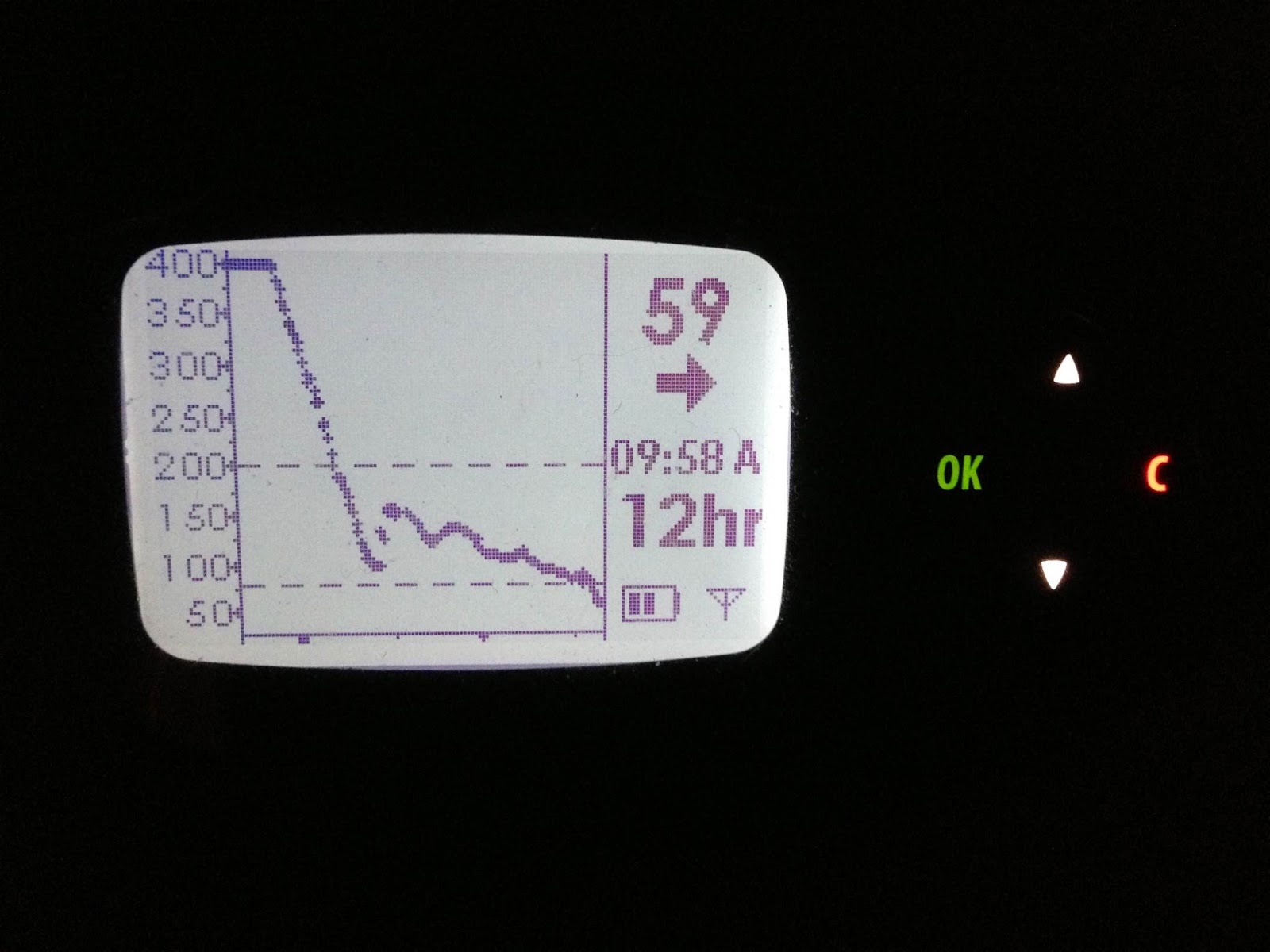
This story begins at about 10 pm, December 31, 2012. My friends and I were standing in a very long line to get in to the bar that we had bought a New Year’s Eve ticket for. Before we had left our hotel for the bar, I had tested my blood sugar and saw that it was far too high, somewhere in the 300’s. I had given insulin and assumed that it would at least be on its way down. While we stood freezing outside in this long line, I took out my dexcom and saw that my blood sugar was riding along the top of the CGM. I tested my blood sugar again and sure enough it was now in the 400s! (it should be around 110). This hasn’t happened in a very long time and I honestly couldn’t figure out why it was so high, I had given insulin for my dinner so it didn’t make any sense. Not only that, it had only continued to rise since I had given the insulin in the hotel, not a good sign.

I started to get concerned. Maybe my infusion set wasn’t working. Was I even getting any insulin? I was incredibly thirsty and now I really had to pee, two common symptoms of high blood sugar. We were still a far way from the front of the line. I felt around in my clutch. That’s when I realized that I had forgotten to put an emergency syringe in my clutch when I switched purses earlier that night. I also couldn’t access my insulin pump to quickly give more insulin. That night I decided to wear a tight skirt so my insulin pump was secured around my upper thigh, not somewhere I could easily get to while in public. I had some decisions to make and I had to make them quickly.
It was a huge hassle to get a cab from our hotel to the bar, with cab companies saying that wait times were over 2 hours. It was now past 10 and the bar only guaranteed our entry until 10:30. My friends would do anything for me so I knew they would go back to the hotel with me if it was absolutely necessary, but I hated the thought that we might not be able to get in by the time we got back. I thought about walking up to the bouncer and pulling the diabetes card so I could cut the line, telling him that I was having an emergency and needed to go to the bathroom to give myself insulin. Even though it was the truth, I still never really like to use my diabetes in situations like that. Plus the line had begun to move and now we were only a couple minutes from being inside.
My friends were getting concerned, asking what they could do to help. Unfortunately at this point, there wasn’t much anyone could do. Within a couple minutes we made our way into the bar and I headed straight for the bathroom. My only choice was to give some more insulin through my pump and hope that it worked. I figured that if in a couple hours, it hadn’t gone down, I would then take a cab back to the hotel to change my infusion set. I made my way to the bar where my friends asked if I wanted a drink. “Just a glass of water” was my reply. I was so thirsty and downed the water almost as fast as my friend’s took their shots. 
I continued to curse myself for not remembering to bring extra insulin and syringes and hoped that the insulin would begin to work. After about an hour, I saw my first sign of hope. The arrows on my CGM had started to point downward, meaning my blood sugar was starting to drop! What a huge relief!! Knowing that the insulin was starting to work meant that I could stay and enjoy the rest of the night with my friends.
Just as we counted down to the new year, I watched my blood sugar go down over the course of the night. It wasn’t until close to 2 am that it was once again stable in the normal range, 4 hours later! I woke up the next morning to low blood sugar, due to my attempts to lower it the night before.
The whole experience was kind of a slap in the face. I had gotten caught up in celebrating the New Year with my best friends and my diabetes has taken a back seat. I still don’t know what exactly caused my blood sugar to skyrocket, but my lack of initial vigilance and forgetfulness had almost cost me my New Year’s plans, besides its effects on my health. It was as if my diabetes was yelling, “I’m still here! Don’t you dare forget about me!” I ended up having a fantastic night with my friends and am so thankful that I was able to get my blood sugar back under control without having to leave, but the whole night was definitely a reminder of how much of a central role my diabetes plays in my life and how it can never be ignored, not even for one night.