Reaching A Milestone

6 months ago almost to the day, you started this blog. You had just gone to the endo that day and she told you your A1c was 8.0%. You and your doctor had been trying for awhile to get it under 7.0. You were angry. You were tired of it being too high. You were scared what this trend would mean for your future. You decided to make a change. You started this blog. You made a commitment to yourself to do better, to try harder.

3 months went by. You counted, you bolused, you corrected, you treated. You broke bad habits and tried to replace them with good ones. You became well acquainted with your CGM, Gigi. You set goals. You got frustrated, but you kept at it. You went to the endo, nervous to see the results of your hard work, nervous that it wasn’t enough. But it was. Your A1c was 7.2!  You dropped .8 in 3 months! It was the lowest in a long time. You were so happy! You felt accomplished. You did that. You reached your goal and set a new one. Next time, you wanted to be below 7.0.

Another 3 months. You kept up the work you had been doing. Some days and weeks were better than others. Your next appointment approached, May 28th. You were nervous that there wouldn’t be an improvement. Mostly because you had been having what seemed like a lot of highs lately. You prepared yourself for news of a higher A1c.

But you were wrong. You know what it was? 6.7%!! You finally made it into the 6’s!! You couldn’t believe it. “Wait, seriously?!” you said to your doctor. She smiled and congratulated you. You couldn’t even remember the last time it was in the 6’s. This was what you had been working towards for so long. You were beyond excited. A giant smile filled your face. You tweeted the DOC the great news from the exam room, and your excitement and happiness was returned with congratulations. You called your Mom to tell her the news, she was so happy she was practically screaming into the phone. You smiled the whole drive back.

You did that. You had a goal and you accomplished it. It took years and it was hard, but you kept at it. You didn’t give up.

I don’t know when you are reading this. It may be 3 months from now, 9 months later, 2 years in the future. Your A1c may be higher than it was on May 29, 2013. Life happens. Maybe you got burnt out, maybe you got lazy. It’s okay. It happens to everyone. But do you remember how it felt that day you heard your A1c was 6.7? How great and accomplished you felt? You can have that again. You can get back there, I know you can. Stop feeling disappointed in yourself that your A1c went back up. Stop feeling discouraged. Stop saying you are a “bad diabetic” because you are not. And stop rolling your eyes as you read this. We all have set backs, it does not mean that you failed. You did it once and you CAN do it again. I believe in you.

But for right now, remember that great day. Remember what it felt like to accomplish a goal that you work on every single day and have been for over 10 years. Remember the joy you felt as you walked out of the doctor’s office with the knowledge that your hard work paid off. Remember that even when you struggle in the future, and you will struggle, that you can get back to this point.

You did it. You can do it. And you will do it again.

I know you will. Congratulations! I am so proud of you!

Love,
Me

Next goal? 6.5%

Live Like Tomorrow is Your Endo Appointment

The few days before a dentist appointment, you’d think I have perfect dental hygiene. I’m not a regular flosser, but those days leading up to my dentist appointment, I floss twice a day and brush super well. For some reason, I convince myself that these few days of flossing will make up for all the days that I wasn’t as good over the past few months. I know that I won’t be able to get rid of the build up of plaque, but it makes me feel better knowing that at least I was good for the week before my appointment, whether it actually made a difference or not.

I have this same attitude when it comes to my quarterly endocrinology appointment. Even though my endo will be staring at my A1c number, a three month summary of my blood glucose numbers, I convince myself that if I’m really “good” for the week before the appointment, it won’t be as bad if my A1c is higher than I want.

“Yes, well 7.8 isn’t what I was going for, but look at how good my numbers have been the past week!”

So the 7-10 days before my appointment, I am extra vigilant. I test my bg more often. I stop swag (scientific wild ass guess) bolusing and am more accurate in my calculations. I try super hard to remember to pre bolus. And usually my blood sugars a week before my appointment are pretty good. Still not perfect, but typically better than other weeks. Since my doctor usually brings a printout of the past 2 weeks of my blood sugars, I feel better having at least one week of pretty good numbers even though that 1 week really won’t make much of a difference for my A1c. My doctor still sees the trends and helps me to adjust ratios and rates, and I feel like I have something positive to contribute to the conversations.

So the question then becomes, why don’t I pretend every week is the week before an endo appointment? Well I’m trying. It’s hard to maintain that constant level of vigilance. But yes, ideally that is the goal. It’s like the Tim McGraw song, “Live Like You Were Dying” except it should really be “Live Like Tomorrow is Your Endo Appointment.”

So tomorrow I have an appointment with my endo. If you recall, my last appointment was great. A .8 drop in my A1c to the low 7s, the lowest in years. Tomorrow’s appointment? I’m not hopeful. I can tell that it’s going to be higher this time, I’m just hoping it’s not too much higher. And I’ve been on vacation the past 4 days. That week of good blood sugars? Yeah not so good. Lots of spikes and dips and highs that take hours to come down.

So pretty much I’m not looking forward to tomorrow’s appointment at all. I’m nervous, anxious, disappointed, and slightly defeated. But probably most important, I’m still determined.

Peanut Butter and Cues To Action

“Peanut butter?”

“Huh?”

“PB. On on your finger.”

“Ohhh. No, it stands for pre bolus.”

Yes. That’s right. It says PB on my finger, in black permanent marker.

One of my biggest challenges when it comes to my self-management is remembering to bolus before my meals. I either remember halfway through my meal, when I finish, or in a few instances, a half an hour after I’m done. I’ve talked about this in an older post and how pre bolusing feels like I am giving up some of my control. However, I know that if I can remember to give my insulin before I eat, I can drastically cut down on my post meal bg spikes. Sometimes it takes hours for these spikes to return to a normal level. I know that all of this will ultimately help to lower my A1c and hopefully finally get me from being in the 7’s to the 6’s. I know what I have to do, now it’s just remembering to do it.

Clearly that’s easier said than done.

This habit of bolusing midway or after eating is so ingrained that I am truly struggling to remember to pre bolus. I’ve tried to think of a few ways to help remind myself. I don’t really eat at the same time everyday so setting an alarm on my phone wouldn’t really work. Plus, I don’t always have my phone visible while at work. Ultimately I decided to try something different. I would give myself a “cue to action.” A visible reminder of a behavior that I want to change.  I figured if I wrote PB on my finger, I would be sure to see it. After all, I use my hands to eat, how can I miss black bold letters written on my hand?

Well, apparently I can. I’ve had mixed results with this pseudo experiment. I do see the PB written on my hand, unfortunately it’s not at times when I’m about to eat. It’s when I’m sitting at my desk working on my computer. When I’m stuck in traffic driving to and home from work. Or when I’m using my phone. Of the few days that I have written PB, I have remembered to pre bolus for only a few of those meals. A few times I remembered, but wasn’t able to because my bg was low. But there were a couple meals that I still completely forgot. I got so caught up in my conversations and food that the thought completely escaped me.

My conclusion? There is potential. Even though I didn’t remember for all my meals, I still remembered for a few. There was some improvement. Maybe writing on my finger is just not the right cue to action. Maybe I need yellow sticky notes physically put on or around my food. A sticky note on my packet of oatmeal. One on my tupperware container. On my dinner plate. Places where I literally can’t miss them. Kind of like the notes my mom used to write for my lunches in elementary school, only way less exciting:

“Hey Reva, PB! Love, Me”

It’s more work, but in this case, the benefit is definitely worth the extra effort.

JDRF Diabetes Today and Tomorrow Conference

This past weekend I had the pleasure of attending the Metro Detroit/Southeast Michigan Chapter JDRF Diabetes Today and Tomorrow Conference. This was significant for a few different reasons:

1. It’s my first JDRF event in…well, years. I’m not sure exactly why this is, but I guess I haven’t really felt the need or desire to go to any events until recently. I donate every year to the JDRF, but it had been a long while since I was at a JDRF sponsored event. Now that I have a little more free time, I wanted to become more involved. And that’s exactly what I plan to do. After meeting people at the conference, I’m looking forward to becoming involved in the local YLC (young leadership committee) of JDRF.

2. Not only was I attending the conference, I was on a panel at it! I was assigned to speak on a panel at the Teen Central, talking about my personal experiences with diabetes to a room full of teenagers. I have to admit, this session was completely eye opening. I was on a panel with 3 other inspiring type 1 diabetics who each had interesting and amazing stories to share. When we started engaging the teenagers, I was shocked at the stories that most of these teens had when it came to the treatment by teachers, substitutes, principles, students, and the like. Substitutes not letting them treat a low or leave to check their blood sugar. Teachers not understanding the urgency of a situation. Principles telling a student to put her pump in her locker even after explaining what it is. Gym teachers making a student keep running even when she said she felt low (testing in the 20s). A coach informing a teen that they could try out for the team but wouldn’t be able to play on it. And the stories went on. They all went on to say how they told their parents, who then called the school and dealt with the situation, but I was so surprised that these instances even happened in the first place. 

Hearing the teen’s stories made me so appreciative for the supportive and understanding environment that I had while I was in school. Maybe I lived in a naive or sheltered diabetes bubble, but I never had situations like the ones being described by the teens at the conference. If I didn’t treat a low in class, it was because I didn’t want to draw attention to myself, not because someone told me I couldn’t. All my restrictions were self-imposed. It truly made me realize how important it is to educate both students and faculty about type 1 diabetes. Even with 504 plans, there still seemed to be some misunderstanding when it came to the needs of the diabetic students. 

I spent much of the rest of the afternoon talking with the teens, which was really enjoyable. I’d forgotten a lot of what it was like to deal with my diabetes in middle and high school and was quickly reminded.

3. I had the opportunity to meet people from the DOC, my first D-meet up! I was very excited to meet Mike from DiabetesMine, Tim from BleedingFinger and Andrea. These were the first people that I have met from the DOC in person after following them on twitter and reading their blogs, so it was very exciting to have the opportunity to talk with them.

Over all it was a great conference. I learned quite a bit and look forward to becoming more involved with JDRF in the future.

Diabetes Blog Week Day 7: Spread the Love


Today’s post: As another Diabetes Blog Week draws to a close, let’s reflect on some of the great bloggers we’ve found this week. Give some love to three blog posts you’ve read and loved during Diabetes Blog Week, and tell us why they’re worth reading. Or share three blogs you’ve found this week that are new to you. 

I want to read every single blog post for every day. I’m pretty sure that’s what I’ll be doing for the next couple weeks. I’ve only scratched the surface with all these amazing posts and I’m looking forward to reading more. My blog roll has certainly grown this week and I know it will only continue to get longer. 

What I’ve most enjoyed about this week is all the different emotions that I personally experienced reading these posts. Some of them made me smile and laugh out loud. Some of them made me sad. Reading a few posts, I was scared for the person, but then happy to hear that everything worked out. Some made me angry! Angry at the mistreatment, injustice, and challenges that people had to deal with. Some heartfelt posts touched somewhere deep inside. Many posts made me happy for the person. Sometimes as I read, I was nodding along, thinking to myself, “I feel the same way!” or “that happened to me too!” I connected to the person and to their experience even though we’ve never met. But most importantly, this week made me feel supported. Your comments and tweets reaffirmed why I started my blog. This week has made me feel both proud and fortunate to be part of the DOC. I can’t wait to read more about your lives and experiences. I know this is the beginning of a beautiful friendship. 

Seriously every blog post I read was amazing, everyone deserves praise for courageously sharing their journey. And I admit that I still haven’t had time to get to them all. But here are my shout outs:

Day 1: Share and Don’t Share. Hannah’s post from Finding Balance gives both her and her mom’s perspective when it comes to what they would and wouldn’t want their endo to know.

Day 2: We, the Undersigned. Jessica wrote a great petition on Mastering Me to the Type 1 individual. A petition for you to live your best life with diabetes. I would definitely sign this!

Day 3: Memories. Kelly’s memory from Diabetesaliciousness got me really fired up. I couldn’t believe the trouble that her and her dad were given at a baseball game, what her dad did to stick up for her, and then how Kelly stuck up for her Dad!

Day 4: Accomplishments Big and Small. Adjoa from A Girl’s Reflections, writes “There is a choice in every diabetes moment, between acting out of love, or out of fear.” She writes a powerful post about learning to value all of her, including her diabetes.


Day 5: Freaky Friday: Jess talks about the common language of chronic illnesses on Me and D and her experience serving on a Teen Advisory board at her children’s hospital with teens that have other chronic illnesses. 

Day 6: Diabetes Art. Meri writes a touching poem to her 3 diabetic boys at Our Diabetic Life. Here’s an excerpt: “My boys, you are my heroes.  I am your biggest fan. Through all that life throws our way, Just keep in mind, “You can!””

What a great week it’s been! I can’t wait until next year’s Diabetes Blog Week!

Diabetes Blog Week Day 6: Diabetes Art

Today’s topic: Diabetes Art
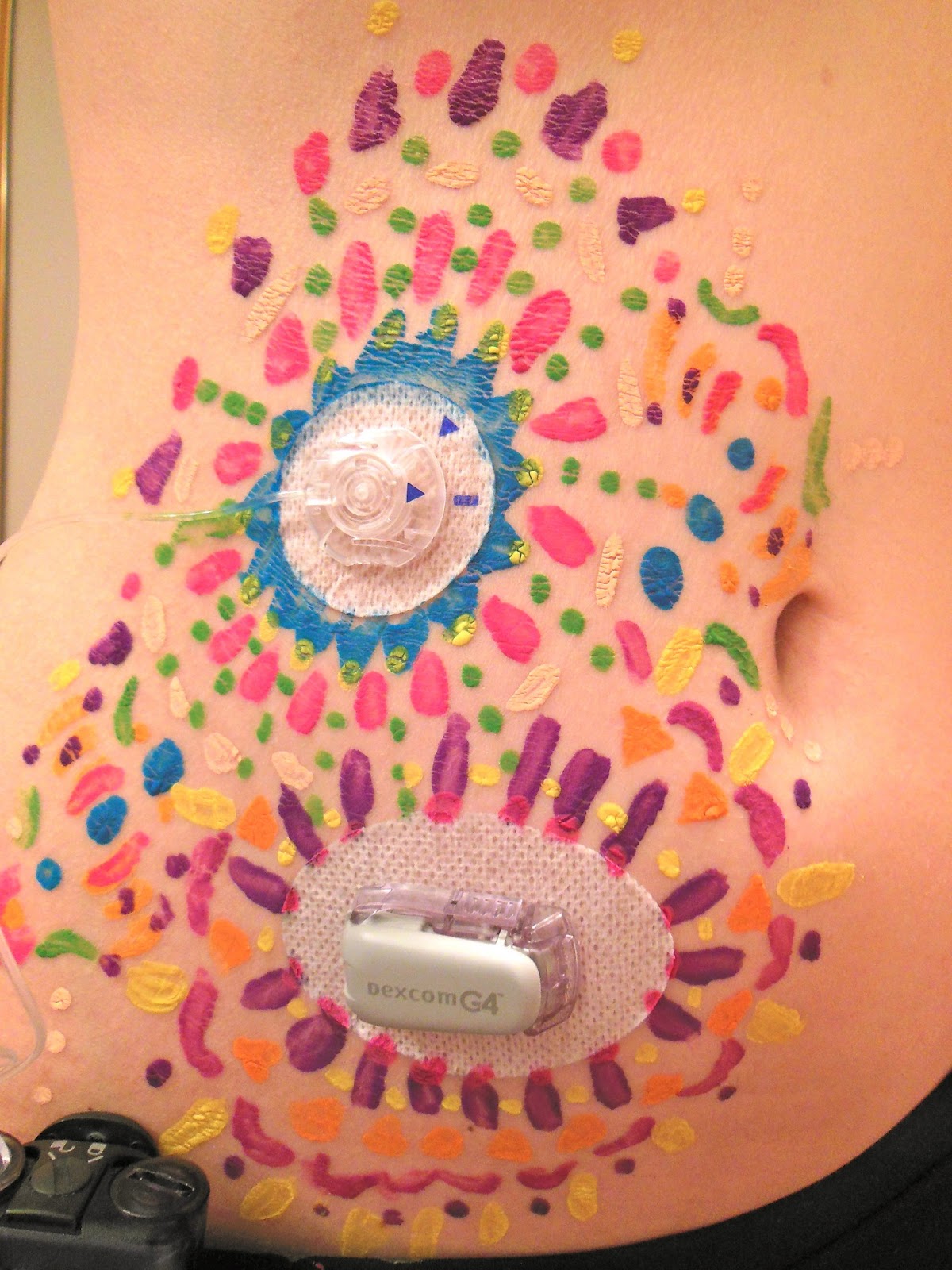
Infusion sets, omnipods, sensors, and tape.
These all look foreign and unusual on your body to someone who isn’t familiar with diabetes.
I’ve spent a lot of time trying to conceal what’s on my stomach, to prevent the stares.
But not today.
Today I want to draw attention to this area.
I want it to be seen and admired. I want it to be viewed as something beautiful.
 I am not embarrassed. I am not ashamed.
I am proud.
I am diabetic.

Diabetes Blog Week Day 5: Dream Diabetes Device Wildcard

 
Today instead of swapping diseases, like today’s topic, I’m going to swap topics. 

Tell us what your fantasy diabetes device would be. Think of your dream blood glucose checker, delivery system for insulin or other meds, magic carb counter, etc etc etc. The sky is the limit – what would you love to see?

I’m going to start by saying that I do not want another device to carry around. Between my pump, meter, CGM, and phone, that is enough devices to have with me all the time. Here’s what I do want. I want an app on my phone that integrates everything on to one platform. But it’s not just going to store blood sugar numbers and insulin doses, oh no. This app is quite sophisticated. This kind of technology has not even been invented yet, that I know of (this will be awesome to read 5 years from now when this dream is a reality). Let me paint you a picture.

You’re out to eat and you ordered this amazing Mexican dish. You aren’t quite sure how many carbs it is though. There’s the rice and the beans, the tortilla, the filling, etc. Maybe you can make a pretty close estimation, but it’s still just a guess. You take out your phone and open the DiaBites App (pronounced die-ah-bite-ees, patent pending).

You take a picture of your food using the camera in the app. Presto! DiaBites brings up a screen that tells you exactly (Yes, exactly! This is my dream device) how many carbs are in the food that is right in front of you. It also breaks down the other nutritional information (calories, sugars, fat). 

But that’s not all this app does! You scroll down. DiaBites tells you exactly how much insulin you should give yourself. You look at the number it’s telling you to bolus. Wait, that seems a little low for all that food. That can’t be right. Don’t worry, it is! DiaBites also takes into account your active insulin and your current blood sugar number. How does it know this information?! It wirelessly collects this information from your pump and CGM. You now know exactly how much insulin you need to give for that delicious Mexican meal.

The DiaBites app has other great features. As it collects your glucose numbers, basal rates, and boluses, it charts your trends and can alert you in text format when you’re blood sugar is too high or low, as well as when it’s rising or dropping at a fast pace. This is similar to current CGM’s although you are able to see and customize the alerts on your phone. The app will also recommend insulin doses based on your calculations to correct for the number. For D-parents, you can set the app to receive text updates from your child’s CGM. You’ll be alerted on your own phone when your child’s blood sugar is above or below the level you set, no matter where your child is. 

Numbers, graphs, charts, and pictures can all be sent to you or your doctor’s email with a push of a button. No more manual tracking of exactly what you ate, how much insulin you gave, and your pre and post blood sugars. DiaBites compiles all this information (including pictures of all your meals) for you in an easy to read daily journal which can be downloaded quickly and easily or uploaded directly from your phone. Don’t worry, you can select if and which pictures to send, just in case you don’t want your doctor to know about that piece of cake.

DiaBites the App, coming soon to iPhone and Android (I wish!!!)


Image from Blogchef.net- Smothered Burrito Recipe


Diabetes Blog Week Day 4: Accomplishments Big and Small

Today’s prompt:  Share the greatest accomplishment you’ve made in terms of dealing with your diabetes. No accomplishment is too big or too small.

I see my accomplishments as building blocks to keeping myself healthy. They honestly all felt like the “greatest accomplishment” at the time. Instead of focusing on just one, allow me to share some with you, starting from the very beginning. (Many of these I’ve already written about so I’ve included the link to past posts)

  1. The first shot that my parents gave me. It was in the hospital after being diagnosed. I hate needles, just receiving a shot was an accomplishment.
  2. The first time I poked my finger. And then eventually being able to do it without crying or having a fit each time. 
  3. The first shot that I gave myself. It was because I was too angry at my mom at the time to ask her to do it. But hey, anger as a motivation still did the trick.
  4. The first time I had a sleepover after I was diagnosed. Being away from my parents when I had become so dependent on them was a big deal, even when it was just for one night.
  5. Switching to an insulin pump and inserting my first infusion set. I passed out the very first time from holding my breath in anticipation. The nurse kindly reassured me that a medical center was one of the best places to pass out.
  6. Inserting my infusion set without numbing my skin first. I used to use Emla cream (a local anesthetic) to numb my skin every time I had to change my set. The day that I decided not to use it was a pretty big deal.
  7. Going to sleep away camp, both diabetes camp and non-diabetes camp. It was a big step to be away from home for an extended period of time and be responsible for my own care.
  8. Deciding that it’s okay that people can see my infusion set (and later, sensor) at the pool. Realizing that I don’t need to hide it, despite the stares.
  9. Taking care of my diabetes in college. That’s kind of a broad one, but an accomplishment nonetheless.
  10. Studying abroad in England for 6 months with my diabetes and traveling around the world. Always an additional challenge traveling with diabetes.
  11. Starting to use my CGM and inserting my first sensor. I still hesitate, but I’m getting better each time.
  12. Switching the sensor to new locations on my body. Sometimes I can be a little reluctant to change.
  13. Starting my blog and sharing my experiences with my readers. I don’t think I could have anticipated how discovering the DOC and blogging would positively change my life.
  14. Having my A1c drop to the lowest it’s been in years at my last appointment. Even if it goes up at my next appointment, at least I know that I can do it.
  15. Realizing that even though having diabetes is not easy, it has given me many other strengths.

I could spend more time talking about each of these accomplishments, but looking at this list (which still doesn’t include a lot of other diabetes achievements) helps me to realize that I truly have accomplished a lot in the past 12 years, many of which were not easy feats. I often get caught up in the day-to-day management of my diabetes. I get upset when I see the daily spikes in my blood sugar or when I have to treat a low in the middle of my workout. Taking a step back to see how far I’ve come since my diagnosis helps to put it all in perspective. Living with diabetes isn’t easy. Each day is a struggle, but I’ve come a long way. Yesterday’s mountain is today’s mole hill. A finger prick that used to bring tears and take 30 minutes now is now an act that I don’t even think about. In a way, every day feels like an accomplishment. 

It’s not just about diabetes though, it’s life in general. Your struggles now may become one of your biggest accomplishments later. These struggles and accomplishments are what help to build your inner strength and character. Big or small, they are what make you the person you are today.


Diabetes Blog Week Day 3: Memories

Today’s prompt: Share your most memorable diabetes day. 

My most memorable diabetes day is without a doubt my diagnosis, but I’ve already written about that.  It’s been hard to think about a particular day or experience that really stands out. The experience I’m going to share may not be my “most memorable”, but it is one that has stuck with me.

One of my favorite spots

Where I went to college, there is an area of land called The Arb, which consists of 123 acres of nature. There are walking paths, an abundance of trees, open fields, a river, and beautiful landscapes. There are always people walking, jogging, picnicking, laying in the sun, and enjoying the outdoors. One of my favorite things to do while in college was to go for a walk in-between or after class when it was nice out. Sometimes I’d find a bench and read or other times I’d walk the paths. The Arb is big enough that you could walk into the woods and be at least 20 minutes from any of the entrances. It was a great place to clear your mind.

I always have fruit snacks with me in case my blood sugar drops low. They are in every coat pocket, backpack, purses, you name it. I remember a particular day during grad school when I decided to go for a walk in the Arb by myself between classes. I reached my hands into my coat pocket and felt the crinkle of a fruit snack packet. I started my walk into the arb, heading for a spot near the river. My blood sugar was fine when I began, but it quickly started to descend. This was before I had my CGM so I had no idea that it was dropping as fast as it was. All the sudden I went from feeling fine to feeling really really low. All I had with me was what was in my pockets (which didn’t include my meter).

I reached my hand into my pocket to pull out my fruit snacks to treat my low. That’s when I realized that what was in my pocket was actually empty wrappers. I had forgotten to throw them away and to replace the stash in my pockets. I didn’t have anything with me to treat the low!

I started to panic. I was probably only a 15 minute walk back to the Public Health School where my belongings were, but running would only make my blood sugar drop faster (or at least that was  my “low brain” reasoning at the time). I started walking quickly back towards the school. I looked around, I couldn’t see any other people near by. I became really dizzy, to the point where the leaves on the trees were blurring together.  I distinctively remember thinking that I wasn’t going to make it back, I honestly thought that I might pass out right there in the middle of the grass. How long would it take for someone to find me? Who would stop? Would they think that I was just sunbathing? Would my friends worry if I wasn’t in class? Would they think to look for me here?

I’ve had a LOT of lows in my life. I’ve had some that were just as bad as the one I was experiencing and some that were even worse. But what made this day memorable was that I was alone. In the woods. Low. Without a way to treat it. It was honestly my worst nightmare come true.

I made it back to the public health school, my head spinning and my heart racing.  I treated the low right away. However, that might have been the scariest diabetes moment I’ve ever had. Scary because it brought up all the “what ifs”. What if I hadn’t made it back? What if I did pass out? What if no one found me for hours?

Now, I make sure that I have a full packet of fruit snacks with me at all times. I always take my phone and if I will be walking somewhere alone, I make sure someone knows where I am. Having diabetes means ALWAYS being prepared. You never know when or where a low will strike.


Diabetes Blog Week Day 2: We, the Undersigned

Todays prompt: Recently various petitions have been circulating the Diabetes Online Community, so today let’s pretend to write our own. Tell us who you would write the petition to – a person, an organization, even an object (animate or inanimate) – get creative!! What are you trying to change and what have you experienced that makes you want this change?
 

In many countries (including the US), Spanish soap operas, telenovelas, play an integral role in people’s lives. However, they are more than just entertainment. They are public service announcements in narrative form. They are carriers of educational messages, reaching millions of people every day. Telenovelas weave health topics into the plot of the show, whether it’s about using condoms, getting tested for STIs/HIV, eating healthy or just going to the doctor. One in three telenovela viewers say that this prime time entertainment TV is their top source of health information, according to the CDC. Entertainment TV has huge potential for carrying educational and health messages to millions of viewers.
 
So why am I telling you this? My petition is to have a character created on the TV show, Glee, that has type 1 diabetes. Glee is not a telenovela or even a soap opera, but it does have many of the same characteristics. As I just described with telenovelas, Glee addresses diverse issues through its stories and characters, reaching 8-11 million viewers. Topics include: teen pregnancy, economic status, race, sexual preference, religion, physical and mental disabilities, sex, school and domestic violence, school shootings, homophobia, eating disorders, sexual assault, drug and alcohol, the list goes on. Using engaging story lines (as well as song and dance) the show brings awareness to and educates viewers on important topics while still providing entertainment.


You don’t have to like the show, many people don’t. What I want to draw attention to is its ability to bring up relevant, complex, and controversial  issues and address them in a way that the audience can relate to and understand. I think it would be a perfect show to have a character that has type 1 diabetes. This person would have diabetes, but would not be the “diabetic” character. They would be multidimensional just like all the other characters. Artie is in a wheel chair, but his character is much more than that. 

The character I’m proposing would have type 1 diabetes, but would not be defined by it. By having such a character, I believe that we can begin to bring awareness and education to viewers about type 1 and type 2 diabetes in a way that can develop over multiple episodes. Rather than having a single episode on a medical show in which there is a short storyline about someone with diabetes, the character on Glee would be someone that has the opportunity to grow and develop. Viewers would have a chance to get to know the character as a person. The character can introduce concepts such as the challenges of living with a chronic disease, self-management, lifestyle modifications, and differences between type 1 and type 2 diabetes. Whether its asthma, diabetes, epilepsy, cystic fibrosis, or some other chronic condition, I think that it is time that there are more positive representation of chronic health conditions on mainstream television. 15-18% of children in the US have a chronic condition. These types of characters on TV can help children, adolescents and adults to not feel marginalized or “different”. They can become a point of reference for children trying to explain diabetes to their friends. “You know that character on Glee? Yea, that’s what I have.”

 
To me, my petition is less about the particular TV show, and more about the fact that a mainstream character with type 1 diabetes is created on primetime television. I chose Glee because I think they do a good job of addressing certain issues, but I admit there may be a better show out there and am open to all possibilities.
 
My petition:
 
We, the undersigned, petition the Fox Broadcasting System and the creators of Glee to create a regularly appearing character on the show who has Type 1 Diabetes.
While many different issues are addressed on this show including characters with unique backgrounds, sexual identities, disabilities, and other characteristics, we believe there is a great opportunity to address a health condition that affects millions of people in the United States. This character can help to bring both awareness and understanding to viewers around the growing health epidemic of Diabetes (type 1 and 2). 
 
Thank you.