Meet the Dario Smart Meter

About a month ago, the company Dario contacted me and asked if I would be willing to test their new diabetes management system and meter. Always interested in trying the latest and greatest, I happily agreed. Dario supplied me with the meter and a limited supply of test strips and I downloaded the app on my phone. So here is my honest review of the meter from my experiences over the past couples weeks.

The Packaging

imageLet’s just say, the meter makes a damn good first impression. I’m someone who appreciates the artistry of a well packaged device. I love opening Apple products for that very reason. All my past meters have just come in a normal box, nothing special. The Dario meter was not like that at all. Every piece had a place, the packaging was slick and sophisticated. It was a pleasure to unpack this medical device, and that says something.

The instructions and reading material was conveniently hidden within the box while the lancets were cleverly stored in a neat compartment next to the meter.

The All-in-One Device

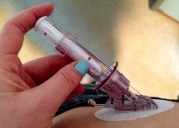
There are 2 things that make this meters and management system so unique. The first is that it turns your smartphone into the meter (more to come on that later). And the second, is that the lancet and test strip holder are combined into one, well designed and easy to use device.

Holding the device, it doesn’t look anything like past glucose meters I’ve used before. Without knowing what it is, I never would have guessed what it was used for, which is great if you like to keep things discreet.

The Lancet

The needle is housed on one end of the device. To access it, you just snap off the top orange piece. You can set the depth of the needle, and then you follow the arrow and pull down on the black piece to load the needle before pressing the orange button to release it. Super simple.

Test Strips

They’re stored on the other end! How awesome is that?! No need to carry around multiple pieces. The cartridge of 25 test strips just snaps into place. You just remove the white piece at the end. The box of test strips came with two 25 test strip cartridges.

The Meter Attachment

The Dario system turns your smart phone into your meter by plugging in a small attachment into the headphone jack. The attachment is also stored in the all-in-one device.

The Meter

The packaging on the box clearly explains how to download and set up the app on your phone, walking you through the set-up. To test your blood sugar, you plug in the attachment and open the app. If the attachment is in correctly, it will prompt you to insert a new strip and then place a drop of blood on the test strip. The meter counts down by filling in a circle before displaying the glucose number. It uses a color coding system to visually show if it’s within range, borderline, or high. It then immediately takes you to a screen that allows you to indicate if its pre-meal, post-meal or a bedtime reading and then insert additional information related to carbs, insulin, physical activity, and even tags.

The App- Tracking and Analytics

Overall, I’m impressed with this app and how intuitive and easy to use it is. I think it does a really good job of logging important information and then displaying it in a meaningful way to the user. You are able to set up a personal profile which includes your blood glucose thresholds, hyper/hypo warnings, and then the type of basal/bolus medication you use.You can sync fitness apps, track food, and set reminders in the app.

Logbook and charts
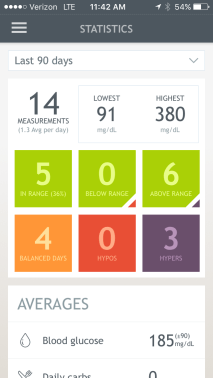
imageThe app automatically stores every reading in the logbook and you can decide if you want to view it more as a list, a timeline or a chart. The chart will graph up to the last 14 days. You can also easily share your logbook either as a PDF or CSV with your phone contacts or by entering an email address.

The statistics tab gives you a great summary for the day, or the last 7, 30 or 90 days. It will tell you how many readings you had, the lowest and highest and then breaks it down by how many were in range, below or above range and then how many hypos/hypers you had based on your settings. If you click the summary box, it will show you all the readings that fell into that category. It also shows on the website that the app estimates your A1c.


Things I like and Areas for Improvement

What I love:

  • I love how everything fits together into one device. Instead of carrying around my pouch with all the separate pieces (meter, test strips, lancing device, etc), all I really need is the one device and my phone
  • It’s great at logging everything and makes it super convenient to share
  • I don’t have to worry about charging my meter, as long as my phone has battery, the meter will work

Some drawbacks/areas for improvement:

  • It’s a slightly slower process. Maybe I’m just used to my old meter, but I find that the whole process takes a little longer to test. Since it’s an app on my phone, I need to unlock my phone, open the app (sometimes it takes a second to load), insert the attachment and then test. Don’t get me wrong, it’s still a relatively fast process, but I found that when I was in a hurry, I resorted back to my old meter
  • It doesn’t sync with any other diabetes devices. This might be the biggest drawback. My other meter at least would send the reading to my pump. This meter doesn’t. So if I’m correcting or bolusing, I have to manually enter my bg number in my pump.
  • My summary feels misleading. I have a CGM that I use in addition to my meter.  Most often it’s when my CGM says that I’m high that I test to get a more accurate number to correct and give insulin. For that reason, high blood sugars are over-represented in my logbook on the app and isn’t really capturing the whole story. If the app was able to integrate with my CGM, it would give a much more accurate picture of my blood sugar history.
  • Greater integration. This is not only with diabetes devices, but also other apps. It’s great that you can link a fitness app like runkeeper, hopefully the list of apps or wearable devices that it links with will continue to grow and include some food tacking apps as well, like MyFitnessPal. It would be great if the app could be used as a one stop shop for diabetes health more generally, including fitness and healthy eating. Also, it would make entering data related to fitness easier. Currently it asks you to enter physical activity as calories burned whereas entering the amount of time would be easier.


Being a cyborg

Maybe I’ve been watching too many comic book and sci-fi movies/shows lately, but I’ve come to the realization that technically, I’m kind of a cyborg thanks to my insulin pump.

Well first, I had to look up the actual definition:

Cyborg– noun
1.
a person whose physiological functioning is aided by or dependent upon a mechanical or electronic device.

My physiological functioning is dependent on my insulin pump essentially acting as my pancreas. And while it’s technically not built into my body (maybe it will be in the future), it’s still attached at all (well, most) times. But upon reading other definitions, most cyborgs’s mechanical or electronic device allows their physical abilities to extended beyond normal human limitations. While my insulin pump makes my diabetes much easier to manage, it’s still not the same as an actual working pancreas and so it probably wouldn’t qualify in that sense.

But that’s not the aspect of the pump that I want to focus on today. Instead, let’s talk about one small feature of it, the light.

IMG_0371My insulin pump has a button that turns on the screen’s back light. This makes it easier to give insulin in the dark. But its uses extend beyond merely giving insulin. I essentially have a built in flashlight at all times.

When I get up in the middle of the night to use the bathroom, I turn on the light and use it to guide me through the dark. Unlike the jarring light from a phone, the brightness doesn’t rouse me from my slumbered state.

My reliance on my light is most apparent when the battery in my pump needs to be replaced and the function stops working. I stumble through the darkness to the bathroom, cursing myself for not replacing the battery when I first noticed it was low. No matter where I am, a dark movie theater, my bedroom, or even a cave, this light is always available (and connected) to me, allowing me to illuminate the darkness. It extends my abilities beyond normal human limitations.

In many ways, my type 1 diabetes has essentially given me both physically and metaphorically, a light in the darkness.


It’s the little things

The sense of accomplishment is a wonderful feeling. And the great thing about it, you can experience it at multiple levels, from big life events and feats that take months or years to complete to everyday occurrences.

What I want to focus on today are life’s small tasks and acts that still give you that empowering sense of accomplishment. These events may not require the same level of work or commitment as the larger accomplishments, but the feeling you get is still one to be relished.

  1. Parallel parking on the first try. Oh man, I’m so awful at parallel parking that any time that I don’t have to repeatedly pull forward and back to get into the spot is a huge accomplishment.
  2. Putting together furniture. I know there are directions and IKEA furniture is not supposed to be all that difficult to assemble, but after the hours that it inevitably ends up taking, it feels so good to stare at the finished piece!
  3. Checking off everything on a to-do list. How amazing does it feel to not only get to cross something off your to-do list, but to finish every task or errand that you planned for yourself in a day?!
  4. Finishing a book. While sometimes it’s hard to get to the end of a book and say goodbye to the characters you’ve become attached to, it feels good to close the cover for the last time.
  5. Getting your email inbox down to a reasonable number. I’m someone who constantly lets my email inbox to get upwards of 5,000 emails. I may open an email, but then I don’t delete it or categorize it, it just sits there. The few times that I’ve actually gone through and sorted or deleted each email to get that number down to the hundreds has made me feel so much more organized and on top of things.
  6. Trying a new recipe and having it come out amazing. There’s always that slight risk of trying a new recipe, whether you’re cooking a meal or baking a dessert, that you fail miserably and end up with something inedible. So to have a new recipe turn out to be delicious is quite an achievement.
  7. Sticking to what’s only on a grocery list. A grocery store can be a minefield of tempting treats and when you’re trying to eat healthy, it can be hard to resist all the delicious, but unhealthy foods. Any time that I can get in and out and only get the foods on my list, I leave feeling very proud.
  8. Improving your workout. Whether it’s beating my time, upping my reps, nailing a new yoga pose, or using heavier weights, it feels so good to workout a little harder than the time before.
  9. Laundry. Seriously any time I do my laundry I feel incredibly accomplished after. It’s just one of those things.
  10. Bolusing perfectly for a complicated meal. This past weekend I went out for pizza and then after, went to a birthday party where I indulged in cake and ice cream. The whole time I kept expecting my blood sugar to spike, but to my surprise and Isuppose credit, my blood sugar stayed stable and in range! It was such an awesome surprise and made me feel so good about my carb counting and bolusing that night.

    IMG_0090

    I love when it stays between the lines


Can I have a re-do?

I often dread my endocrinologist appointments. But at the same time, I’m thankful for the 4 appointments each year. They’re forced moments of reflection, confrontation, and adjustment. Before each appointment, I consider how things are going. I know if the past 3 months have been good or bad. If it hasn’t been a good 3 months, it’s a time to confront myself and delve into why my numbers have been high or low or just all over the place. Sometimes it’s my own self-management habits that have slipped, other times it’s factors that are out of my control like getting sick. Then based on how things are going, I make adjustments along with my doctor and move forward.

Today was one of those appointments that I just wanted to get over with. The past month and a half has been rough. My numbers have been running high consistently. Between getting a pretty horrible cold that lingered, having to go on steroids for the sickness, stress from a breakup, adjusting to time changes of traveling, and then just a weird couple weeks where it seemed like my insulin wasn’t working as it normally does, I knew my doctor would be looking at some pretty awful numbers at our appointment.

Part of me is disappointed. I don’t like to be this off track. I don’t like knowing that I’m potentially doing lasting damage to my body, that I’m increasing my risk of complications. But I also know that life happens. There’s a lot that I can’t control and those events may unfortunately impact my health by way of my blood sugar. All I can do is my best to try to manage the consequences.

Diabetes is a chronic disease. It means that as of right now, I’m stuck with it for the long haul, it’s not going anywhere. And as much as I get caught up in these mini 3 month sprints between appointments, there’s a bigger picture. Three months is not very long when you look at a lifetime. And shit happens. There will be highs and lows in life just as there are in my blood sugar. I admit, I’ve had other things on my mind lately besides my diabetes and I’m sure that’s played a part. But I can’t control everything that happens, at some some point you have to let go and just do the best you can within your circumstances.

So yea, I’m not thrilled about this appointment and the past few months. But unfortunately there’s no re-do’s or rewinds with a chronic condition. What’s done is done. Now, I’m putting aside my excuses and focusing on moving forward.


Diabetes Valentines

My Valentine’s day diabetes pick-up line post has been one of my most popular posts, so I decided to do something similar this year.

Diabetes Valentines!

Happy Valentine’s Day!


The Teenage Tree of Trust

Being a teenager is hard. Being a teenager with type 1 diabetes…well, it has its own challenges.

A couple of weekends ago I had the opportunity to volunteer as part of my local JDRF’s Teen Carnival. The event brought together about 42 teens with type 1 diabetes and their parents to encourage an open dialogue about their management of their diabetes.

The teens and the parents were broken up into separate rooms. The teens were given questions to discuss about their parents while the parents answered questions about their teens. The exercise was called the Tree of Trust. Answers were written anonymously on “leaves” and then hung on the tree for everyone to read. After the separate conversations, the parents and teens were brought back together. A local pediatric endocrinologist summarized the responses from both the parents and teens and provided recommendations based on his years of experience working with teens and adults in his practice, highlighting themes that were expressed during the session.

IMG_9686It was powerful to hear both the teen and parent perspective. Parents were reminded about the importance of giving their teen independence and not to be so quick to anger or blame when things don’t go well, while teens learned the importance of honest and open communication with their parents, even when they make mistakes.  As I looked around the room from the back row where I sat, I saw parents and teens exchange knowing looks and sly smiles as different topics related to them and their relationship. While it’s challenging to manage your diabetes as a teen, everyone in the room had already taken a great step in the right direction just by being there and listening.

I was a moderator in the teen room and sat at a table with another moderator and 4 teens. As we talked about each of the questions, I was struck by how similar my struggles were as a teen. I remember the challenges of trying to fit in with my peers when my diabetes set me apart, of trying to be independent, and having so much to think about at all times.

I didn’t have the opportunity to participate in a program like the Tree of Trust when I was a teen. I think I had pretty good communication with my parents as a teen, but it still would have been an interesting exercise to go through together. Well since I can’t travel back in time, I decided to go through and answer the questions now, as a 27 year old, remembering my years as a teenager. I sent my mom a sampling of the questions that were asked at the session and had her answer them also.

____________________

Questions for the Teen

(so these are my responses about my parents, thinking back to when I was a teenager)

1. What do we do well as parents and what do we do with your T1d care that is successful? (I combined two questions since they’re so closely related).

You’ve done an amazing job since the day I was diagnosed of teaching me that I am not my diabetes, and that I can do anything I want to do even with my diabetes. You encouraged me to play sports, to go away to camp, to travel (and years later to study abroad), and just be myself. Whatever the situation, you found a way to make it work with my diabetes. This was such a strong message for me as a teen that I internalized growing up. You also allowed me to be independent while still being a concerned parent. You helped me when I needed help, but you encouraged me to take responsibility for myself and my diabetes.

I remember checking my number and shielding the number from you. I think it was because at the time, I wanted my privacy even when it came to my diabetes care. And I appreciate that most of the time you respected that and trusted me to do the right thing. You always just wanted me to be safe and healthy, you never got mad even when I was going through a rough time with trying to get my numbers under control.

2. What can we do differently with your T1D care?

I know that you’re just concerned, but it can be annoying to constantly ask me what my blood sugar number is, or remind me to check my blood sugar or to bolus. Most of the time I have already done it, and if I do miss it, it’s a lesson for me to learn. While I do appreciate the reminders occasionally, they don’t need to happen constantly. I also get annoyed when I say I don’t feel well and the first thing you’ll ask is what my number is. Not everything about my health is related to my diabetes, and usually I can tell the difference between not feeling well from being high or low or there being something else wrong.


Question for parents

(these are my mom’s responses about me)

1.What did I do well as a teen and what could I have done differently?

You wanted to be very independent with managing your diabetes from the very beginning which is most positive. Dad helped with the more technical aspects of the pump, ordering insulin etc. I helped with the logistics, wearing the pump in clothing, school lunches etc. I think counting carbs has been a challenge throughout the years.

2. What did I do with my t1d care that bugged you?

Nothing “bugged” me about your own t1d care. (ok, wiping your bloody finger on your case).

3. Why do you not trust us?

I’ve always trusted you. Double checking on t1d care would only be a sign of love and concern when a parent who does not have diabetes cannot “fix” this condition for their beloved child. It is not judgmental in any way. When you have a loving, respectful, trusting relationship, you work through things together.

4. What did I do with my T1D care that was successful?

Accepting with grace, courage, dignity and even humor, this unwanted and challenging aspect of your life. Taking steps in your life to find a way to help others with this same disease and other health issues. Using your gifts of introspection, insight, intelligence and sensitivity that shines through in all you do.

5. What did I do with my T1D care that disappointed you?

Nothing that you did with your t1d care disappointed me. You are, were and will forever be my hero.

____________________

I know how fortunate I am to have parents that have always been there to love, support, encourage, and believe in me in everything I do, including managing my diabetes. Being a teenager with diabetes was definitely challenging at times, but looking back, I can see how everything I went through made me and my relationship with my parents stronger in the end. I hope other teenagers and parents have the opportunity to go through a similar exercise as the Tree of Trust, or take it upon themselves to have a similar conversation.

A sticky situation

“I am rubber, you are glue. Whatever you say bounces off of me and sticks to you.”

Wouldn’t it be nice if some things did stick though? (Mean words excluded).

Sticky generally isn’t a term that I would use to describe humans, yet the ability for foreign objects to stick to my body has become a very important aspect of my life. Nothing is worse than spending the time to fill, insert, and adhere a pump infusion set or sensor to your body only to have it fall off before its time because the tape failed to do its job…to stick.

Shortly after starting on my CGM, I invested in some heavy duty tape to put over the sensor so that it would stick longer. I had that roll of tape for close to 2 years before it finally ran out. And for the most part it was great, it definitely allowed my sensor to stay attached to my body longer. However, after some time, the tape would really start to itch! And the only way to get relief was eventually ripping the tape and subsequently the sensor off. And then often I’d have a rash around where the tape was for a few days. While in hindsight I realize I didn’t really need to finish the roll before getting something new, I did anyways.

IMG_9557This time around I did my research and found a tape that would hold, but wouldn’t cause a rash. I read countless websites and blogs and finally found one that I thought would work. It’s made from a fabric material and coated with hypoallergenic adhesive. The tape is called Hypafix. I have to say all in all, I’m super impressed with it.

Pros:

  • It sticks! It’s been holding just as long as my old tape if not longer, lasting in the 2 week range.
  • Feels good. It’s super soft and flexible.
  • Less rashes. I’m not getting the same kinds of rashes. I admit it still does itch after some time, but it’s not as bad and isn’t leaving a lasting rash.
  • Easy removal. I’m able to remove the piece of tape from over my sensor without pulling the sensor tape off too. This allows me to replace the tape more easily.

Cons:

  • Slow drying. Since it’s fabric, after a shower it stays wet longer and occasionally I find a wet spot on my shirt from pressing against the tape.
  • Still itches. See above about still being a little itchy. But usually it happens around the time that I should be replacing the sensor anyways.

So yay for new tape!

Continuing with the theme of sticky things…I decided that my CGM and sensor could use a new look. I’ve always really loved the idea of Pump Peelz, awesome adhesive covers for insulin pumps and other diabetes accessories. They come in tons of different designs, it was hard to choose just one! I still want to get one for my pump too! I have to say, I definitely enjoy looking at my CGM a little more now (even when I don’t like the number I see).


The CGM Courtship

For the most part my continuous glucose monitor, Gigi, and I are inseparable. We’re attached at the hip, well technically more like the lower abdomen. Over the years, I’ve noticed that Gigi and my relationship has fallen into a pattern. As far as relationships go, it may not be the most functional relationship, but it is consistent. And by being predictable, I’ve learned how to make it work for both of us.

Mine and Gigi’s relationship cycles about every 2 weeks. And while the overall nature of the relationship may be the same, each encounter is slightly different.

Day 1: We meet. Again.

3a318-photo11Sometimes it’s been a while since we’ve  last seen each other, other times only a couple of hours. This first encounter has gone many different ways. Sometimes it’s smooth and painless. We connect effortlessly. Other times, it’s awkward and hurtful. On a few occasions, we have to start completely over, the discomfort and inadequate connection too much to bear. But eventually we make it through this initial introduction.
Day 2-4: The courtship.

These first few days together I’m optimistic, yet cautious. I can tell Gigi is trying to give me what I need, but she can’t completely be trusted yet. Our connection still new, we’re still out of sync. These days are spent aligning our desires. When Gigi tells me something, I often have to verify with another source. But these calibrations make us stronger together.

Day 5-11: The sweet spot.78db7-photo39

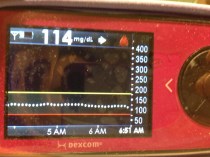
With time, we hit a groove. We’re in sync. We become completely trusting of each other. We are one. When Gigi tells me I’m low or high, I believe it. Gigi’s screen reflecting what I feel, the beeps and vibrates warning me of danger. I can count on Gigi to be there for me, to be fully present and connected.

Day 12-14: The beginning of the end.

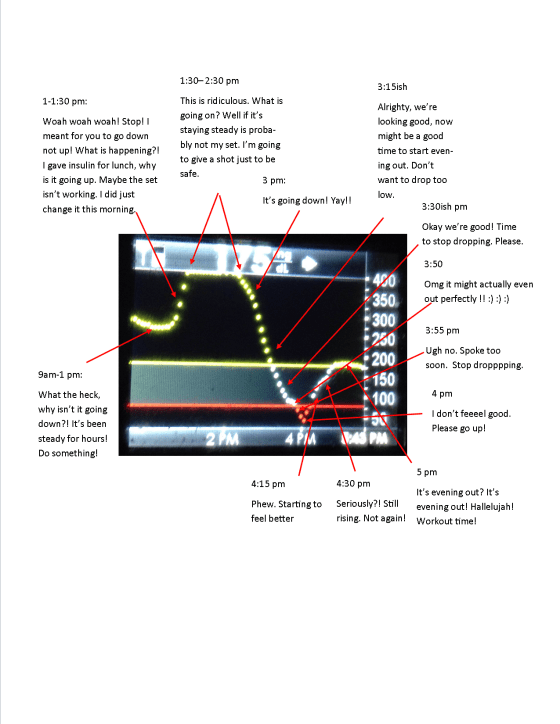
Like any relationship, aspects of Gigi start to become annoyances. Gigi becomes a physical itch that can never quite be scratched, never feeling gratified in my efforts to find the comfort I once had. The beauty of our connection begins to fade, the tape that once held us together, no longer sticking. My distrust of Gigi starts to return. Sometimes Gigi just disappears for no reason, replaced by a signal reminding me that our connection is breaking and out of range. Other times, we don’t seem to be communicating at all, Gigi completely mystified and communicates only with ???. And the lies! Gigi tells me I’m low- 55, but I feel fine. When I check my other source it says I’m 155, how can this be?! But it’s not all bad. There are stretches when Gigi is perfectly normal, and its for this reason that I can’t bring myself to end things quite yet.
Day 15ish: The break up.

Finally, it all becomes too much. The distrust, the lies, the disappearing. Gigi can no longer be counted on to display the truth and be depended on when I need it. The physical discomfort grows. So I do it. I rip the tape off in one decisive yank and end things once and for all. The redness on my skin remains as the memory of the past 2 weeks fade. For a moment I savor the unattached freedom. But this feeling is fleeting, already I miss the valuable insights that Gigi gives me. I miss the comfort of always knowing where I stand, I miss the control that Gigi affords me. I miss Gigi.

And so it begins again.

Day 1: …


Blackout

I know better than to compare a fictional story to real life. But yet I found myself doing just that, trying to comprehend the experiences of a character that were so foreign to me, but unfortunately probably familiar to many others. In the book, the character is an alcoholic, often drinking so much to help her cope with life that she blacks out. Multiple times she wakes with a feeling of guilt, knowing that she did something wrong, something embarrassing, something out of character, but not being able to remember what she did.

“I wake with a crushing sensation of wrongness, of shame, and I know immediately that I’ve done something stupid,” she says.

I’m not going to get into the struggle and devastation that alcoholism can cause for the person and those around them. That is not what this post is at all about. What I do want to focus on is the fact that what troubled this character was the need to remember these missing memories so that she could take full ownership of them and their consequences. Without being able to remember what the character had done during those missing hours, she felt unable to take responsibility for her actions and to feel fully accountable.

As she says, ” I know what I’m responsible for, I know all the terrible things I’ve done, even if I don’t remember the details- but I feel distanced from those actions. I feel them at one remove.”

Why did this aspect of the book strike me so much? It’s not like I could relate to the character. In fact, I think it was exactly my inability to relate to the situation that stuck with me. It’s not that I haven’t made mistakes that I’ve felt guilty for. I’ve regretted or questioned decisions, but I’ve always been able to remember what led to them and fully take responsibility for them. And until I read this book, I’ve completely taken this simple fact for granted. While we do make mistakes and have regrets, we are still in control of our actions. When you take responsibility for what you’ve done, you can learn from it, put it behind you, and move forward.

A couple months ago, I made some changes to my lifestyle. I started following a nutrition and exercise plan. And for 2 months I stuck with it for the  most part. I saw changes in the way my body looked, I lost a little weight, I became leaner and stronger, and my A1c dropped, I felt good. And then the holidays came. With the countless holiday parties, eating more meals out, going on a cruise, and being off my normal schedule, I started making less healthy decisions. I ordered dessert, I snacked into the evening, I ate the fries instead of switching to a healthier side, I grazed through parties eating even though I wasn’t hungry. I got off track.

About a week ago, I woke up in the morning full of regret. On my CGM was proof of the decisions I made the night before, my entire night dancing above the 180 line, dipping and rising. My stomach not quite itself, I knew I was still feeling the effects of my earlier choices. But unlike the character in the book, I remembered what led me to this point. I could recall the unhealthy decisions that I had made. But instead of feeling defeated, I felt empowered! Because by knowing what got me to this point, I also know what I can do differently next time. I can prevent this feeling. Your memories and emotions, as negative as they might be, don’t need to be what holds you back, they can be motivators to propel you forward.

This past week, I got back out my nutrition plan and started fresh. I know that I’ll slip up from time to time, but I’m on the right path. And the regret that I felt, while not desirable, was a catalyst to get me back on a healthy path, and for that, I can’t regret my regret.